Every year, thousands of nonprofit organizations, and mission-driven organizations invest significant time, energy, and organizational resources into producing an annual report. A dedicated staff member or team spends weeks gathering program statistics, compiling financial summaries, writing narrative content, coordinating with leadership for approvals, and working with a designer to produce a polished PDF document. The report is published to the website, shared in a single email blast, and posted on social media with a link.
Then, quietly, almost nothing happens. Download rates are low. Engagement is minimal. The donors who receive the email open it, maybe glance at the cover, and move on with their day. The annual report that represents weeks of organizational effort produces a fraction of the engagement that a well-crafted social media post would have generated in fifteen minutes.
This is not a hypothetical scenario. It is the lived experience of the vast majority of nonprofits and mission-driven organizations that produce traditional annual reports. And it raises a question worth sitting with: if the goal of the annual report is to communicate impact, build donor trust, and strengthen the case for continued support, why do so many of them fail to do any of those things?
The answer, as usual, is not the content. Most nonprofits have genuinely remarkable impact to share. The answer is the format, the distribution, and the fundamental misalignment between how organizations present their annual impact and how their audience actually consumes information in the current media environment.
“Most nonprofits, and mission have genuinely remarkable impact to share. The problem is the format, the distribution, and the fundamental misalignment between how impact gets presented and how audiences actually consume content today.”
Why Traditional Nonprofit Annual Reports Fail to Drive Engagement
The traditional annual report was designed for a different era. When donors received physical mail, when organizational credibility was communicated through the weight and production quality of a printed document, when a twelve-page PDF felt like an act of generosity rather than an act of optimism, the annual report made sense as a primary impact communication vehicle.
That era is over. Today, the average attention span of an online reader is measured in seconds, not minutes. The content competing for your donor’s attention is produced by professional media organizations, algorithmically curated social platforms, and marketing teams with nine-figure budgets. A PDF that requires a download, a scroll through dense program statistics, and the cognitive effort of connecting financial data to real human outcomes is simply not competing in that environment.
This does not mean your organization should stop communicating its annual impact. It means you should stop communicating it in a format that was designed for a different audience in a different era using a different distribution model. The data your annual report contains is genuinely valuable. The stories behind that data are genuinely powerful. What needs to change is how you break that content open and deliver it to your audience in formats they will actually engage with.
Break Your Annual Impact Into a Content Campaign Instead of a Single Document
The most effective nonprofit impact communication strategy in the current media environment is not a single document. It is a campaign. Instead of consolidating your year’s worth of impact into one PDF that your audience will not read, break it apart into a sequence of content pieces, each one focused on a single story, a single statistic, or a single insight, and distribute those pieces across multiple channels over weeks or even months.
Here is what this looks like in practice. The financial summary that would have been buried on page eight of your annual report becomes a standalone infographic posted to social media and embedded in your newsletter with a simple visual explanation of where the money goes and what it produces. The program statistics that would have appeared in a dense table become a series of individual social posts, each one featuring a single striking number with a human story attached to it. The donor spotlight that would have been a paragraph in the printed report becomes a short video testimonial shared across email, Instagram, and LinkedIn. The executive director letter that would have opened the PDF becomes a standalone LinkedIn article or a blog post on your website.
This approach produces multiple pieces of high-quality content from a single investment in impact documentation, extends your impact communication across the full calendar rather than concentrating it in a single week, gives your audience multiple opportunities to engage with your story across the channels they actually use, and creates compounding SEO value for your website over time as each blog post, landing page, and resource adds to your domain authority.
The Nonprofit Impact Page: Your Annual Report’s More Effective Replacement
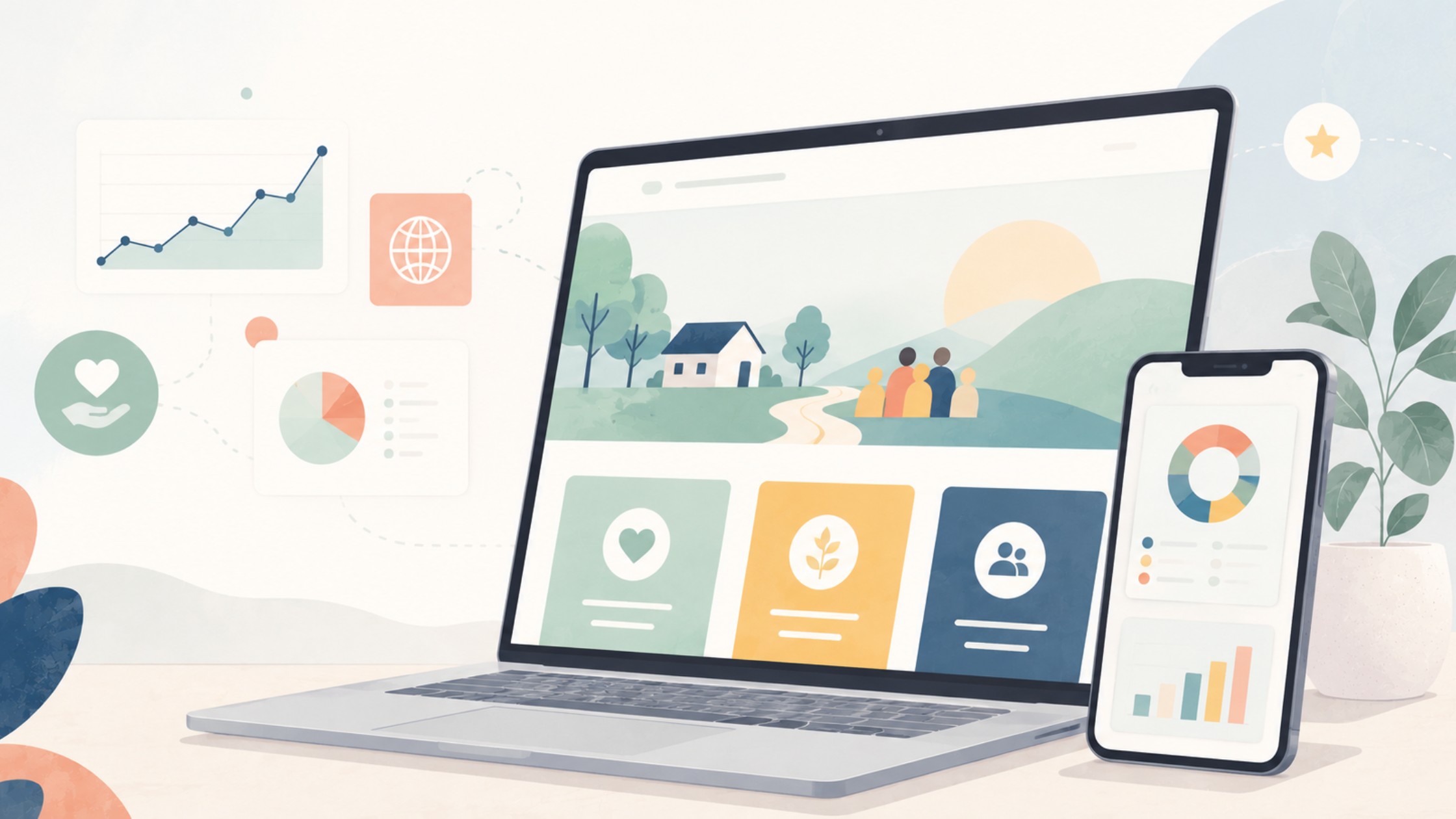
One of the most powerful alternatives to the traditional PDF annual report is a dedicated impact page on your organization’s website. An impact page is a visually rich, mobile-optimized web page that presents your organization’s annual outcomes in a format designed for online reading and sharing rather than for print.
An effective nonprofit impact page includes a hero section with your organization’s most powerful impact statistic and a short, emotionally compelling headline that frames the year’s work. Below that, individual sections cover your key program areas, each one leading with a specific human story before presenting the supporting data. Financial transparency is presented visually, using clear charts or infographics rather than dense tables. Testimonials from donors, program participants, and community partners are woven throughout. And every section includes a clear call to action that invites the visitor to donate, volunteer, share, or engage in whatever way is most relevant to your current organizational priorities.
The impact page also serves as an SEO asset in a way that a PDF download never can. Every word on the page is indexed by Google, which means that potential donors, volunteers, and program participants searching for organizations like yours can find your impact content through organic search. Over time, a well-optimized impact page with regularly updated content becomes one of your most valuable digital marketing assets, driving consistent inbound traffic from audiences who are already looking for what you do.
How to Use Video to Make Nonprofit Impact Content Irresistible
If there is one content format that consistently outperforms every other in terms of engagement, emotional resonance, and shareability, it is video. And the annual impact reporting season is one of the best opportunities your organization has to create video content that communicates your mission in a way that words and statistics simply cannot.
You do not need a professional production crew or a significant budget to create impact video content that works. The most effective nonprofit impact videos are often the ones that feel the most authentic, a program participant sharing their story in their own words, a staff member walking through what a typical day looks like in the field, a community partner explaining what the collaboration has made possible. Shot on a quality smartphone with good natural lighting and clean audio, this kind of content can be more emotionally compelling than a polished production that feels corporate and distant.
Short-form video content, optimized for platforms like Instagram Reels, TikTok, and LinkedIn, is particularly powerful for impact communication because it meets your audience where they already are rather than asking them to seek you out. A sixty-second video featuring a program participant describing how your organization changed their trajectory will reach more potential donors than a twelve-page PDF ever will, at a fraction of the production cost and with exponentially more emotional impact.
Repurpose your video content across platforms strategically. The long-form version lives on your YouTube channel and is embedded in your email newsletter. The short-form clip goes to Instagram Reels, TikTok, and LinkedIn. A still image pulled from the video becomes a social post. A transcript becomes a blog post. One powerful piece of video content, handled with intention, can produce weeks of high-quality impact communication.
Email as a Nonprofit Impact Storytelling Channel
Your email list is one of the most valuable assets your organization has, and the annual impact season is one of the best times to use it with genuine strategic intention. Instead of sending a single email with a link to your annual report PDF, build an email sequence that delivers your impact story across four to six messages sent over the course of four to eight weeks.
The first email in the sequence leads with your most powerful individual story from the year, no statistics, no financial summaries, just a human story told with specificity and emotional honesty. The second email introduces your biggest impact statistic but contextualizes it in terms of what it means for real people rather than what it means for the organization’s performance metrics. The third email addresses financial transparency directly, with a clear, visual explanation of how donor contributions were invested and what outcomes they produced. The fourth email features a donor or community partner testimonial that speaks to the experience of being part of your organization’s community. The fifth email makes the ask, connecting every piece of the story delivered in the previous messages to a specific, compelling reason to give or engage right now.
This sequenced approach produces dramatically higher engagement than a single annual report email because each message is focused, digestible, and emotionally resonant on its own terms. Donors who open even two or three messages in the sequence will have a richer, more emotionally compelling experience of your organization’s impact than they would from even the most beautifully designed PDF document.
The Annual Report Is Not Dead. The Annual Report PDF Is.
To be clear, annual impact reporting is not optional for a mission-driven organization. Transparency about your outcomes and your finances is a cornerstone of the donor trust that makes your organization’s growth possible. What is optional is the format. And the PDF format, as the primary vehicle for that transparency, is one whose time has passed.
The organizations that are winning the donor engagement battle in the current environment are not the ones producing the most elaborate printed documents. They are the ones that have figured out how to take the same richness of impact information and deliver it in the formats, channels, and cadences that match how their audience actually spends their attention.
Your impact deserves to be seen. The question is not whether to communicate it. The question is how to communicate it in a way that your audience will actually engage with, remember, and act on. Rebuild your annual impact strategy around that question, and you will find that the story you have been trying to tell has been powerful all along. It just needed a better stage.